Workforce Strategy and Planning
Strategic Imperative
In an era defined by rapid technological change, shifting market dynamics, and evolving workforce expectations, the institutions that thrive will be those that treat workforce strategy as a core pillar of competitive advantage. We help organizations move beyond reactive hiring to proactive, science-driven capability planning that ensures long-term institutional resilience.
Our approach is rooted in African intelligence—combining global best practices with deep contextual understanding of the markets in which our clients operate. We recognize that effective workforce strategy cannot be imported; it must be engineered for the specific institutional context and cultural reality of each organization.
Our Methodology
Capability Mapping
Identify current and future capability requirements aligned with institutional strategy, ensuring your workforce has the skills, knowledge, and attributes needed to deliver on your strategic ambition over the next 3–7 years.
Gap Analysis
Data-driven assessment of talent gaps and critical succession risks, utilizing advanced analytics and scenario planning to identify both quantitative and qualitative capability shortfalls.
Roadmap Design
Comprehensive acquisition and development roadmaps for institutional continuity, combining targeted hiring, strategic development, and thoughtful succession to ensure no critical capability is left exposed.
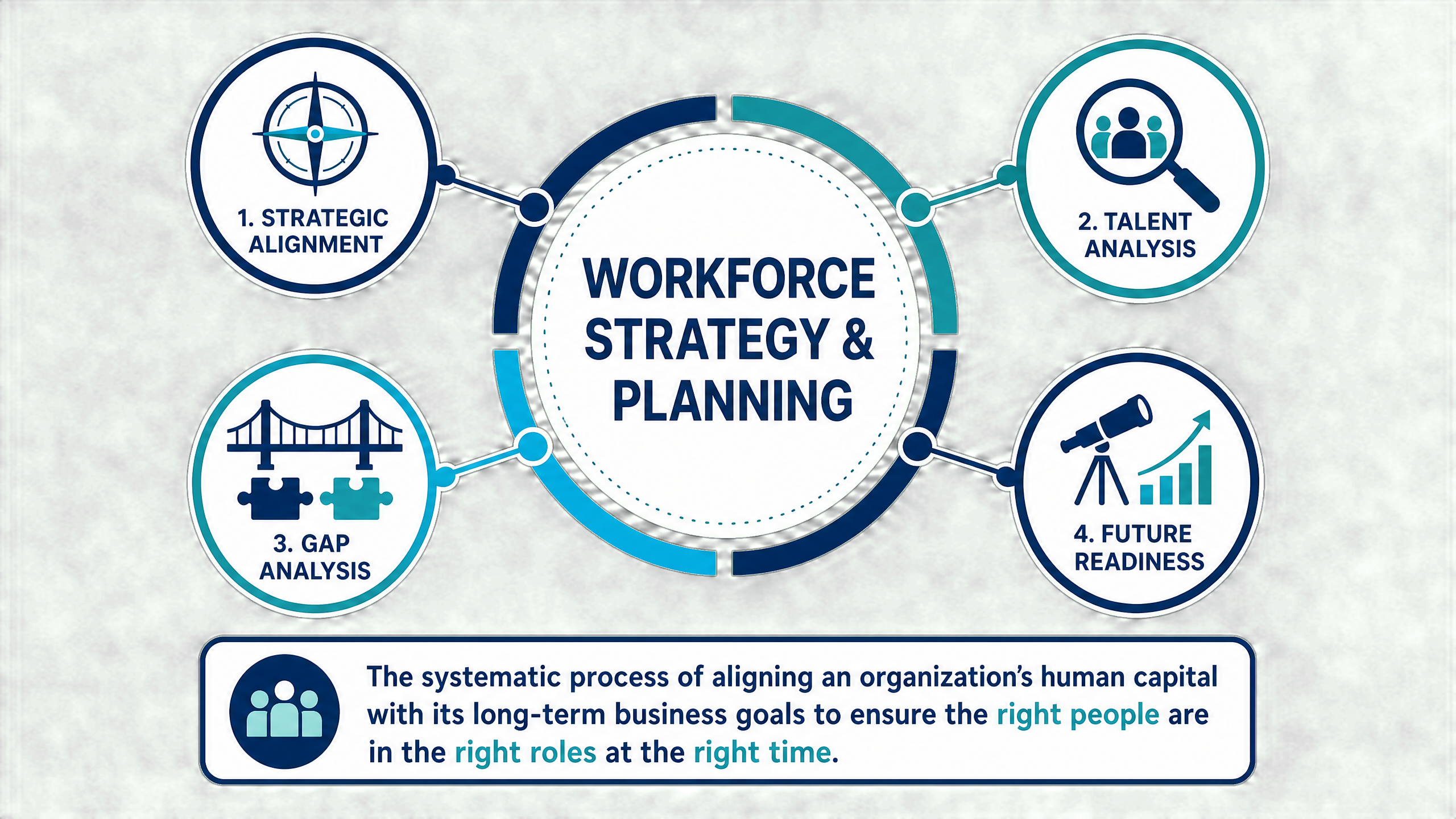
Building the Workforce That Will Drive Tomorrow's Success
The future of every organisation is ultimately determined by its ability to attract, develop, deploy, and retain the talent required to execute its strategy.
Yet many organisations continue to make workforce decisions reactively—responding to immediate operational demands, filling vacancies as they arise, and addressing capability gaps only after they begin to affect performance. While these approaches may solve short-term challenges, they rarely create the workforce capability required for sustainable long-term success.
At Talent Matters, we believe that workforce planning is not an HR exercise.
It is a strategic business imperative.
It is the process through which organisations align their human capital investments with their strategic ambitions, ensuring that the right capabilities, leadership capacity, and workforce structures are in place to support future growth, operational excellence, innovation, and organisational resilience.

As organisations navigate increasing economic uncertainty, technological disruption, demographic shifts, changing workforce expectations, and evolving competitive pressures, the ability to proactively anticipate workforce needs has become a defining characteristic of high-performing organisations.
How We Help
Our Workforce Strategy & Planning practice helps Boards, Executive Committees, and leadership teams develop a clear understanding of the workforce required to achieve their strategic objectives—not only today, but over the next three, five, and ten years.
We help organisations move from:
- → Workforce administration to workforce intelligence
- → Workforce management to workforce strategy
- → Reacting to talent challenges to proactively shaping organisational capability
Why Workforce Strategy Matters
Organisations often invest significant resources in strategic planning, business expansion, digital transformation, operational improvement, and customer growth initiatives.
However, many strategic plans fail not because the strategy itself is flawed, but because the organisation lacks the workforce capability required to execute it.
The reality is simple.
Every strategic objective depends on people.
- Growth depends on talent
- Innovation depends on capability
- Transformation depends on leadership
- Operational excellence depends on workforce effectiveness
Without a Workforce Strategy
Organisations expose themselves to significant risks, including:
- • Critical skill shortages
- • Leadership succession vulnerabilities
- • Workforce capacity constraints
- • Reduced organisational agility
- • Increased recruitment costs
- • Talent retention challenges
- • Knowledge loss from key employee departures
- • Misalignment between workforce capabilities and strategic priorities
- • Reduced ability to execute organisational strategy
Workforce strategy provides organisations with the visibility, insight, and foresight required to mitigate these risks before they materialise.
Our Approach
At Talent Matters, workforce strategy is approached through a business lens rather than a purely human resources perspective.
We begin by understanding the organisation's strategic direction, growth ambitions, operational requirements, transformation agenda, and future challenges.
From there, we assess whether the current workforce possesses the capacity, capability, structure, and leadership depth required to support those ambitions.
Our methodology combines strategic analysis, workforce analytics, organisational diagnostics, leadership assessments, and future workforce modelling to provide a comprehensive understanding of workforce readiness.
The result is a practical and evidence-based workforce strategy that enables leadership teams to make informed decisions regarding talent investment, workforce development, succession planning, organisational design, and capability building.
What We Offer
Strategic Workforce Planning
Strategic workforce planning enables organisations to anticipate future workforce requirements and develop actionable plans to address emerging talent needs.
Rather than focusing solely on current staffing levels, strategic workforce planning examines how future business objectives, market conditions, technological changes, and organisational priorities will influence workforce demand.
Our consultants work closely with executive teams to identify:
- • Future workforce requirements
- • Emerging capability needs
- • Workforce risks and vulnerabilities
- • Leadership pipeline requirements
- • Critical skills shortages
- • Talent supply and demand dynamics
- • Future workforce scenarios
Workforce Analytics & Talent Intelligence
Effective workforce decisions require more than intuition. They require evidence.
Talent Matters leverages workforce analytics to transform workforce data into strategic insight.
We help organisations understand the factors influencing workforce performance, talent retention, leadership readiness, productivity, capability development, and organisational effectiveness.
Our workforce analytics capabilities provide insights into:
- • Workforce demographics
- • Employee turnover trends
- • Talent retention risks
- • Workforce productivity indicators
- • Capability distribution
- • Succession readiness
- • Leadership pipeline strength
- • Diversity and inclusion metrics
- • Workforce cost optimisation opportunities
Critical Role Identification & Talent Risk Assessment
Not all positions within an organisation carry the same strategic significance. Some roles have a disproportionate impact on organisational performance, operational continuity, revenue generation, stakeholder confidence, regulatory compliance, and strategic execution.
Our consultants help organisations identify critical roles and assess the associated workforce risks.
This process evaluates:
- • Business criticality
- • Knowledge dependency
- • Replacement difficulty
- • Talent scarcity
- • Succession readiness
- • Leadership continuity risks
- • Operational vulnerability
Future Capability Planning
The skills that drive organisational success today may not be the skills required tomorrow. Technological advancement, automation, artificial intelligence, digital transformation, evolving customer expectations, and changing business models are fundamentally reshaping workforce requirements across industries.
Organisations that fail to anticipate these changes risk developing capability gaps that undermine future competitiveness.
Our Future Capability Planning engagements help organisations identify:
- • Future skill requirements
- • Emerging leadership capabilities
- • Workforce transformation needs
- • Digital capability requirements
- • Reskilling priorities
- • Upskilling opportunities
- • Future workforce structures
Workforce Capacity & Resource Optimisation
Many organisations face ongoing challenges balancing workforce costs, productivity expectations, service delivery requirements, and operational efficiency.
Workforce capacity planning provides organisations with a structured approach to understanding whether resources are appropriately aligned to organisational priorities.
Our assessments evaluate:
- • Workforce utilisation
- • Staffing levels
- • Workload distribution
- • Resource allocation
- • Organisational productivity
- • Functional effectiveness
- • Cost optimisation opportunities
The objective is not simply workforce reduction—it is workforce optimisation. We help organisations ensure that resources are deployed where they create the greatest strategic value.
Succession & Leadership Pipeline Planning
Leadership continuity remains one of the most significant risks facing organisations today.
Many organisations struggle to answer critical questions such as:
- • Who is ready to step into key leadership roles?
- • Which critical positions lack successors?
- • Where do leadership capability gaps exist?
- • How prepared is the organisation for future leadership transitions?
Our workforce strategy engagements integrate succession planning and leadership pipeline development to ensure organisations are building sustainable leadership capacity. This enables leadership teams to proactively address succession risks while strengthening organisational resilience and long-term sustainability.
Workforce Strategy for Transformation
Periods of transformation place significant demands on organisational capability. Whether organisations are pursuing digital transformation, restructuring, mergers, acquisitions, growth initiatives, or operating model redesign, workforce readiness becomes a critical determinant of success.
Talent Matters helps organisations assess whether the workforce is prepared to support transformation objectives.
Our advisory services focus on:
- • Change readiness
- • Workforce transition planning
- • Capability development
- • Leadership preparedness
- • Workforce redesign
- • Stakeholder alignment
- • Organisational resilience
What Clients Gain
Our Workforce Strategy & Planning engagements provide organisations with far more than a workforce report—they provide a strategic blueprint for organisational capability.
Greater Strategic Alignment
A workforce that is directly aligned to business objectives and future priorities.
Improved Decision-Making
Evidence-based workforce insights that support executive and board-level decisions.
Reduced Talent Risk
Proactive identification and mitigation of workforce and succession risks.
Enhanced Organisational Agility
The ability to respond effectively to changing business conditions and workforce demands.
Stronger Leadership Pipelines
Sustainable leadership development and succession readiness.
Future Workforce Readiness
Clear visibility into future capability requirements and workforce needs.
Why Talent Matters
At Talent Matters, we recognise that workforce strategy is not about predicting the future with certainty.
It is about preparing organisations to succeed regardless of what the future brings.
Our consultants combine expertise in workforce planning, organisational effectiveness, succession planning, leadership assessment, and strategic advisory to help organisations build workforces that are resilient, adaptable, and capable of delivering sustained value.